The Vivo Aqueduct
On 15 May 1914 the water that flowed from the Vivo source, on Mt. Amiata, after years of difficult work, finally reached the Porta San Marco. . . .
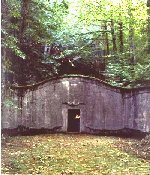 Arriving at the decision to build the Vivo aqueduct was not, however, so easy given that in the course of time there were bitter clashes between the promoters of a completely new system and those who maintained that it would be sufficient to increase the number of cisterns and to find new springs that would be able to increase the yield of the ancient bottini that had until then been sufficient to satisfy the city's needs.
In 1886 studies and investigations were made on the Arbia, Elsa,
and Massellone rivers; however none of them offered the hoped for results.
In 1892, while the majority of the population pressured the civil
administration because the water from the Fontebranda was being
raised mechanically to the highest part of the city, a project was
presented that would bring water from the Vivo springs to Siena.
The 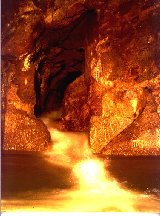 estimate of the cost, about three million lira (now about fifteen billion lira), brought an explosion of violent and protracted arguments that continued until Florentine interest in the same water from Mt. Amiata pushed the administrators to begin the negotiations to buy the water rights before it was too late.
In August of 1895, after the Pignone Foundry Company had surveyed the route, and after a technical commission had examined eighteen springs and established that the only possible and satisfactory diversion would be that of the Vivo, the leadership brought the proposal of making an agreement with the owners of the spring to the city council. . . .
The contract was signed on 14 September and in the following months,
among growing arguments, the city sought the means of financing this
enormous enterprise. . . .
After various vicissitudes, Mayor Enrico Falaschi signed the final
purchase contract, on 16 December 1898, at a cost of 51,423 lira.
However, it can be inferred that not everything went smoothly if Bargagli Petrucci could say in 1930, refering to the aqueduct, that there was still "litigation pending with the owners of the springs."
Much more time passed, characterized by financial, legal,
and design difficulties, before the work could be begun.
In 1903 the engineer Luciano Conti of Florence was chosen to lead the
project. In the same year, the Monte dei Paschi bank, in consideration
of the importance and magnitude of the work, granted an annual concession
of 100,000 lira, for a duration of 35 years, to be paid back from the income the system produced.
As we have noted, the main pipeline was finished in 1914, and although the distribution network 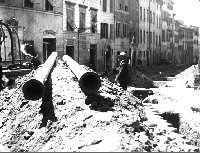 was definitively completed in 1918, the majority of individual dwellings and the numerous lesser branches into various nearby neighborhoods were finally connected many years later.
In sum there were ten years of grueling labor, in the course of which many technical, practical, and economic difficulties were overcome (it is enough to recall that the initial estimate of 3.5 million lira rose to 8 million as a result of underestimating the costs involved), but in the end Siena gained one of the most modern and functional water supplies in Italy, with water of optimal quality and abundant daily flow that would accord incalculable benefits to the entire citizenry.
It was a grandiose enterprise for its times, bringing water over 64 kilometers from its source and then distributing it to the city and its vicinity through a network of another 35 kilometers of water mains. . . .
Reproduced with permission from: Luca Luchini, Siena dei nonni, vol. 1 (Siena: Ed. AL.SA.BA., 1993).