| Jack Whelan's Strategic Communications Site |
Basics
Office: Paccar 529
Phone: 206 261 2495 (text/VM)
Office Hours: see top of Courseblog
Reading
Gregg Hardcopy
Practice
Links
Forms
Courseblog
Office Hours Week of 6/1: Friday 11-12--or by appointment. Check Canvas page for meeting link.
Here is the link to the Midterm Review recording.
Monday, May 18, 2020
Clip of the Day
Wednesday, May 13, 2020
Clips shown in Class 13
Midterm Study Tips
- Be familiar with these film clips
- Use the study guide!
- Review material presented on course website, particularly "Terms You Should Know".
- Be prepared for skill questions: passive voice identifying & flipping; rewriting wordy, static sentences; situation analysis; who/whom.
- Be prepared for concept questions: e.g., key phrase associated with ‘proactive’. Review coursepack and slides.
- PTO questions: Mainly correct usage mistakes. Review 'verbal abuse', 'comma sutra' & ‘saying is believing’.
- Presentation zen--especially stuff emphasized in class. Know what a 'slideument' is, for instance.
Monday, May 11, 2020
Here's an interesting article about why there is resistance to the Hansen proposal for a Sodo location for an NBA arena. Read it if you are interested in doing the persuasive talk topic on the City Council vote on such an arena.
Seth Godin Clip
Terms You Should Know:
Synathroesmus: piling up of adjectives or other modifiers for hyperbolic, often comic effect. Example: That worthless, dirty, rotten, good-for-nothing, thieving, mother-loving SOB!
Catalogues: Lists of objects, events, or ideas that add specificity and vividness to your writing. Example: It was your typical downtown, fair-trade kind of coffee shop, with a dog chained out front, students inside chained to their laptops, and a long line of hipster types waiting for their coffee.
Triad: Any list of words of clauses with three elements in it. I came; I saw; I conquered.
***
David Brooks on the importance of soft skills in a future shaped by artificial intelligence:
In the age of smart machines, we’re not human because we have big brains. We’re human because we have social skills, emotional capacities and moral intuitions. I could paint two divergent A.I. futures, one deeply humanistic, and one soullessly utilitarian.
In the humanistic one, machines liberate us from mental drudgery so we can focus on higher and happier things. In this future, differences in innate I.Q. are less important. Everybody has Google on their phones so having a great memory or the ability to calculate with big numbers doesn’t help as much.
In this future, there is increasing emphasis on personal and moral faculties: being likable, industrious, trustworthy and affectionate. People are evaluated more on these traits, which supplement machine thinking, and not the rote ones that duplicate it.
Read the rest of the article if you want to know his ideas about the other soullessly utilitarian future.
***
How to Make a Good Speech Better
This time of the quarter is about integrating what you have learned. I recently came across an interesting five-minute speech by a very articulate high school student regarding teacher evaluations and the Common Core. I thought it might be useful for me to use the tools taught in class to evaluate it. Watch the clip, and then read my analysis that follows it:
Analysis
Primary Objective: To argue against adoption of the common core and a rigid, test-based teacher evaluation system (Apex).
Audience: Primary: Not clear. Looks like a school board. Secondary: Teachers in audience. The rest of us in YouTube Land
Resistance Frames: People in the audience are likely influenced by those who think teachers are to blame for the educational achievement gap. They they think incentivizing teachers with carrots and sticks based on rigorous evaluations will improve teacher performance and close the gap. They need a way to measure performance, and the best way to do that is by quantitative measurement of student progress on standardized tests. The audience wants data because it can be objectively evaluated; the process is otherwise too subjective. If the goal is to get the audience to vote No on adoption of the common core and the Apex teacher evaluation system, you have to work within that frame or crash it.
Ethos: Student doesn't try to establish his own credentials; he relies on his passion and eloquence, pathos and logos, to establish his credibility. His credibility largely lies in his precocity--the smart, idealistic, articulate young person that adults love.
Counterframe Strategy: Three pronged:
First, attack legitimacy of the process by which the common core was developed and adopted. This part of the speech does not seek to challenge the Data-centered frame described above; it tries to show that there is no solid data or research that supports the common core, there was no democratic process to legitimate it, and suggests that the people pushing it have a conflict of interest. [I think this is a pretty powerful indictment, and should give the audience pause.]
Second, attack the effectiveness of the Apex teacher evaluation system by promoting a more positive image of teachers, and by ridiculing the idea of teachers jumping through flaming hoops by holding them accountable for something they can't control--the engagement and motivation of their students. [I think this section could have been stronger. I would have added arguments about teachers and intrinsic motivation a la Dan Pink. Carrots and sticks don't improve results for people who do high-level cognitive work.]
Third, crash the data-centric "industrial model" frame from which the proposed high-stakes testing and teacher evaluation systems have been developed. Argue that these systems are designed for what's good for bureaucrats and not for what's good for student learning. Plead for education policies that are designed for humans, not robots. Education is about creativity, appreciation, and inquisitiveness, not just job training. [I think this is the strongest part of the speech.]
Tactics: Lots of facts. Uses irony, questions, quotes, analogy, and impassioned (yang) delivery.
My Critique: I think this is a fine speech, but it could have been better if it followed the Ciceronian strategy I teach in class. The opening is weak. His comments about hoping he can be disproved, I guess, are intended to show he's open minded, but I think they waste time and muddy the waters. He does nothing to establish his credibility, but given the time constraints, it could be argued that his credibility is carried by his passion, his verbal agility, and his intelligence. He can get away with a weak opening because he will have no problem getting his audience's attention.
I think a bigger flaw lies in that his problem/solution dynamic is weak. His Narration section, where he lays out the "facts" about the illegitimate process by which the Common Core was adopted, makes no attempt to show that he understands the "problem" from the audience's point of view. He needs to address the pathos frame that the audience is living in, which is the desire to close the achievement gap. That should be the key to his developing a motivating problem.
The student speaker isn't addressing that as a problem or proposing an alternative solution. So it's easy for the audience to say, "I admire your convictions, but I'm still stuck with a serious problem, and while my solution isn't perfect, at least I'm trying to do something. What's your alternative." He has none, at least not one that he emphasizes. "Do no harm" is implied, but he needs to emphasize it more.
Regarding the close, Ben Franklin quote was a nice touch, and I liked his punchline last sentence, but I didn't find the longer McFarland quote helpful. Too much noise and not enough signal. What does he want his audience to do? It ends on a negative--not that, but then what? Vague change?
The student's argument lies on a demonstrative (values) level--it's about legitimacy, conflicts of interest, and robots v. humans. I agree with him (see below), but he needs to add a deliberative dimension (we can go this way or that way), even if it's to make an argument that to do nothing is better than to do something that has so much damaging potential. It's not clear what alternative action step he wants the board to take. If it's 'do no harm', he has to make that clearer.
I am sympathetic to the argument this student is making. But to a large extent it plays to the people sitting behind him more than it does to the people on dais before him. The people on dais are his primary audience because they are the ones making the decision. It might get some of the undecided board members to consider wanting more time to think before voting, but I think a more effective argument is possible.
I have made a very similar demonstrative argument here in Education Week. My goal in it is to crash the technocratic frame, and to offer a alternative humanistic frame. It is not policy oriented. If I were testifying before that board, I would focus more intently on a making a concrete policy choice: Don't go this way; go that way.
***
For those of you interested in a follow-up to some of the grammar problems we talked about this quarter, here's an interesting article in the NY Times about hyphen use, danglers, and the restrictive and nonrestrictive use of commas.
Tuesday, May 5, 2020
Clips used in Class 11
Clooney confronts his brother-in-law-to-be
Simon Sinek's Golden Circle:
***
Yes We Can. In class I excerpted a part of Obama's speech after his primary defeat in New Hampshire to provide an example of the use of the 'epistrophe'. This is one of Obama's best rhetorical moments.
Here's the original speech. You will also see that in other parts of the speechhe uses the yes-we-can repetition also as an 'anaphora'--beginning sentences and clauses. "Yes we can" is also what we might call a 'mantra'.
Here's the will.i.am version:
Compare with Clinton's conession speech in New Hampshire in 2016. (See below.) Clinton's is not a terrible speech, but it has no poetry. Clinton is trying to sell her formidable experience and competence--her ability to do a good job. That's very logos-y. And what have we learned about Logocentric arguments this quarter? There's some pathos in Clinton's rhetoric, but it feels, at least to me, to be forced. It's not who she is. She is someone who would make a very competent CEO, and people who think that's what a president should be were inclined to support her. Bernie Sanders's speeches don't have much poetry either, but they have a passion that is not at all forced, and he combines it with a Logos-y analysis that combines with pathos that creates a very powerful "mythos". He's truly angry about how the "establshment"--the colluson of pollitical and financial elites--has had such a destructive effect on American democracy. People who believe his story are inclined to support him.
Mythos comprises all the stories that we tell ourselves that give our lives meaning and purpose, a meaning and purpose that motivates action. Aristotle said that Logos gives us the facts, but mythos gives us the meaning. Mythos is the big story that a group's ethos is embedded in. Sanders has a story about how ordinary people have lost their country to a few very wealthy elites. He also is promoting a story about how ordinary Americans can take it back. Trump is telling a similar story, but in a more more a white nationalist key. Trump's story is about making America great again. People who think that America is in decline as a world military and economic power are inclined to support him.
Clinton tried to argue in a logos-y way during the primary that Sanders's story is really a myth in the negative sense of the word, that it has no basis in reality, that he won't be able to deliver on his promises. Maybe she's right; maybe she's wrong, but people are far more excited about Sanders's message because he comes across as a no-b.s., believable messenger, and his message awakens the purpose motivation in a way that Clinton's messaging just does not. In that respect Sanders is more like Obama's and is he gave trouble to Clinton in the same way that Obama did in 2008.
Obama's message in 2008 was very similar to Sanders's message in that he promised then to change the rules of the rigged game played in Washington. Many of Obama's supporters became disillusioned with his presidency because they came to believe that once elected Obama didn't even try to change the game. He accepted the rules of the rigged game and just did what he could to enact an agenda within the rules defined in a rigged system. He was logos-process oriented rather than pathos-purpose oriented. He did not govern the way he campaigned. I don't think that anybody who supports Sanders believes that if Sanders were elected that he wouldn't try to change the rules. He might try and fail, but he would try.
Steps for raising sensitive issues:
- Ask for a time to meet
- Raise the issue in a yin tone
- Ask questions to give him opportunity to explain
- Look for places to agree
- State how you look at it differently
- Agree on a solution.
Steps for responding to criticism:
- Don't react defensively, no matter how outrageous the accusation.
- Try to understand what is at the heart of the other's complaint--ask questions.
- Look for places to agree.
- Accept or reject criticism.
- If you accept, then agree on a solution
- If you reject, give your reasons in as yin a tone as possible.
If you are interested in the extra credit, have your conversation, then email me to tell me what the issue was, what your optimal outcome was, and what you thought would be an acceptable outcome. I'll make a decision about whether your story is appropriate to tell before class on Tuesd ay, and I'll let you know before class.
Terms You Should Know:
Anaphora: Repetitions in which the repeated word, phrase, or clause comes at the beginning. Example: "Where is the Life we have lost in living? Where is the wisdom we have lost in knowledge? Where is the knowledge we have lost in information?" T.S. Eliot [This quote also uses erotesis.]
Epistrophe: Repetitions in which the repeated word, phrase, or clause comes a the end. Example: "Where affections bear rule, their reason is subdued, honesty is subdued, good will is subdued, and all things else that withstand evil, for ever are subdued." — Thomas Wilson
Symploce: Repetitions in which the repeated word or phrase comes at both the beginning and the end: “The opposite of love is not hate, it's indifference. The opposite of art is not ugliness, it's indifference. The opposite of faith is not heresy, it's indifference. And the opposite of life is not death, it's indifference.” Elie Wiesel [This quote also uses antithesis]
Another example: "There is no Negro problem. There is no Southern problem. There is no Northern problem. There is only an American problem." Lyndon Johnson [This quote also uses antithesis in that in contrasts the first three items in the list with the last.]
Hypophora: Rhetorical question that both asks an answers the question. Example: "Is this any way to run an airline? You bet it is.
Erotesis: For our purposes, a piling on of one rhetorical question after the other to create dramatic intensity. Example: See opening of Simon Sinek TED talk above.
Wednesday, April 29, 2020
Terms You Should Know:
AIDA: Attention--create receptive space; Interest: establish a motivating problem; Desire: Make audience want your solution--prove your solution solves problem (primary benefit), show all the ways it adds inessential vlaue (secondary benefits; Action: Close the deal--present a next action step that the audience has to say Yes or No to.
Hypophora: Ask a rhetoriical question, then answer it. "Is this any way to run an airline? You bet it is.
Chiasmus: AB BA pattern that often creates a clever antithesis. "You can take boy out of the country, but you can't take the country out of the boy.
Anadiplosis: AB BC CD, etc., usually with a punchline to sum it up. We saw a ridiculous example in the Animal House clip, but it can be used to make a more serious point, too:
Watch your thoughts, they become words.
Watch your words, they become actions.
Watch your actions, they become habits.
Watch your habits, they become your character.
Watch your character, it becomes your destiny.Here are some other examples:
***
EQ Tip of the Day: Is the look that your are projecting to the world one that you have chosen, one that your mood created or one that you tend to lean on by default? What you project reflects how you feel, and it's up to you to understand it.
For instance, what you wear sends a pretty clear message about how you feel. Wearing old sweatpants and ratty T-shirts and having disheveled hair every day tells the world you've given up, while overdressing for every occasion and never missing your weekly haircut lets people know you are trying too hard.
When you meet new people are you aloof and cool, or are you overeager to please? Be aware of how your emotions affect your demeanor, and think about whether they are helping you or undermining you.
***Interesting article in the New Yorker entitled "Seattle Leaders Let Scientists Take the Lead. New York's Did Not." It contrasts the response of King County/Seattle area officials to the Corona Virsu as compared to the New York area. The whole article is worth reading, but I thought this paragraph was relevant because it echoes much of what I'm saying in class:
Epidemiologists also must learn how to maintain their persuasiveness even as their advice shifts. The recommendations that public-health professionals make at the beginning of an emergency—there’s no need to wear masks; children can’t become seriously ill—often change as hypotheses are disproved, new experiments occur, and a virus mutates. The C.D.C.’s Field Epidemiology Manual, which devotes an entire chapter to communication during a health emergency, indicates that there should be a lead spokesperson whom the public gets to know—familiarity breeds trust. The spokesperson should have a “Single Overriding Health Communication Objective, or sohco (pronounced sock-O),” which should be repeated at the beginning and the end of any communication with the public. After the opening sohco, the spokesperson should “acknowledge concerns and express understanding of how those affected by the illnesses or injuries are probably feeling.” Such a gesture of empathy establishes common ground with scared and dubious citizens—who, because of their mistrust, can be at the highest risk for transmission. The spokesperson should make special efforts to explain both what is known and what is unknown. Transparency is essential, the field manual says, and officials must “not over-reassure or overpromise.”
The lead spokesperson should be a scientist. Dr. Richard Besser, a former acting C.D.C. director and an E.I.S. alumnus, explained to me, “If you have a politician on the stage, there’s a very real risk that half the nation is going to do the opposite of what they say.”
Tuesday, April 28, 2020
Clips used in Class 9:
This is a fun clip on Bush as genius of the "identity strategy":
***
Here's the link to the Alec Baldwin AIDA speech form Glengarry Glenross
***
Terms You should know:
Rhetorical Frame: It's the dominant ideas, values or emotional framework within which a persuasive message is presented. A logos frame appeals to facts, analytical prowess, competency, practicality, getting things done. An ethos frame appeals to the speaker's power, credibilitiy, likability, charisma, attractiveness, humor, good guyness, which can often trump a logos frame. Pathos frames work with the desires and fears of the audience. Ryan uses a pathos frame for Bob in the Up in the Air clip when he reframes Bob's pity party as an opportunity to do what he's always wanted to do, and as a more effective way to win the respect of his children.
Identity Strategy: Deployed when goal is to win over your audience by using ethos-centric rhetorical techniques designed to show the audience that you are one of them, that you can be trusted, that your values align wih their values. It uses tribal language, code grooming (shibboleths, dog whistle language, etc.)
Denotation & Connotation. Denotaton is the dictionary definition of a word; connotation are the ideas and feelings that are associated with a word. 'Fortuitous' denotes by chance or accident, but it connotes good fortune. Don't use a word to convey its denotative meaning if it's likely to be understood by its connotative meaning.
Code Grooming: Using language that has special resonance or meaning with your audience that it would not have for people outside who don't "get it". It's a tactic for deploying the identity strategy.
Motivating Problem: What you seek to establish in the Interest phase of AIDA. It's about focusing audience awareness of a problem they may only be dimly aware of or feel is not worth paying attention to. The goal is to fan a low-heat problem into a high-heat problem so as to make audience so uncomfortable that they are desperate for a solution.
Primary Benefit: Part of the Desire phase of AIDA. It's whatever it takes to prove to your audience that your solution solves the motivating problem.
Secondary Benefit: A sweetener that adds inessential value. When deciding between two vacuum cleaners for the same price that do an equally good job of solving the motivating problem, you might decide on the basis of secondary benefits, perhaps one has an attachment that adds value the other does not.
Dog-whistle Language: political messaging employing coded language that appears to mean one thing to the general population but has an additional, different or more specific resonance for a targeted subgroup. The phrase is often used as a pejorative, because of the inherently deceptive nature of the practice and because the dog-whistle messages are frequently distasteful to the general populace. The analogy is to a dog whistle, whose high-frequency whistle is heard by dogs but inaudible to humans.The term can be distinguished from "code words" used in some specialist professions, in that dog-whistling is specific to the political realm. The messaging referred to as the dog-whistle has an understandable meaning for a general audience, rather than being incomprehensible.
Journalist Craig Unger wrote that President George W. Bush and Karl Rove used coded "dog-whistle" language in political campaigning, delivering one message to the overall electorate while at the same time delivering quite a different message to a targeted evangelical Christian political base. William Safire, in Safire's Political Dictionary, offered the example of Bush's criticism during the 2004 presidential campaign of the U.S. Supreme Court's 1857 Dred Scott decision denying the U. S. citizenship of any African American. To most listeners the criticism seemed innocuous, Safire wrote, but "sharp-eared observers" understood the remark to be a pointed reminder that Supreme Court decisions can be reversed, and a signal that, if re-elected, Bush might nominate to the Supreme Court a justice who would overturn Roe v. Wade. This view is echoed in a 2004 Los Angeles Times article by Peter Wallsten. (Source: Wikipedia)
Political Correctness: Mainly, rules of behavior and speech--i.e., an etiquette--designed to minimize offense between groups with different values and worldviews that live side by side in a pluralistic society. Political correctness rules are generally resented by legacy groups that feel they should be playing a dominant role in the society and that others should adopt their legacy attitudes and behaviors, and resent giving equal status to groups they consider outsiders or newcomers. There is some room for disagreement where to draw the line between legitimate frank speech and speech that is obsessively overconstrained for fear of giving the least offense. Common sense and common decency should govern what is appropirate, but often does not.
***
Friday, April 24, 2020
Weird Al on Grammar
Clip Shown in Class 8:Terms you should be familiar with:
Hidden Verb: Any word or phrase that is not a verb that has a verb hiding in it. For example, nouns like 'answer' or 'request' can also be used as verbs. Phrases like 'financial advantage' (see next entry below) have the verb 'save' hiding in it. Then there are a whole category of nouns that have Latin or Greek roots that are verbs plus the endings -ment, -ance, -tion, -sion, sis. So 'government' or 'governance' is hiding the verb 'govern' which you liberate when you knock off the ending.
Static Sentences: Sentences or clauses in which a state verb, mainly the verb 'to be', is used as the predicate: The financial advantage is ten percent after taxes. Solution: We will save ten percent after taxes. Trick is to find the hidden verb that in the original is hiding in the phrases 'financial advantage', which really means 'save'. The verb 'to be' is useful in description, but should be avoided when trying to create an energetic warm sentence style.
Active Voice: Any clause that uses a transitive verb and includes an actor, action, and object in that order: The carpenter hit the nail.
Passive Voice: Any clause that has an actor action and object in which the object is the subjec and the actor is the object of the preposition, usually 'by': The nail was hit by the carpenter. Often the actor will be implied rather than explicitly identified as in "The nail was hit" when the prepositional phrase 'by the carpenter is just dropped.
Mantra: For our purposes a phrase or slogan that verbally identifies the "crux", the energy center of a group, a project, or a business. It uses language that is brief, unique, and memorable. "Fight for the inch", "Fast, healthy, food", "Democratize design". It achieves with maximum signal and minimum noise what a mission statement usually fails to do.
Conjunctive Adverb: Like coordinating conjuctions, they connect independent clauses. Typical conjunctive adverbs are however, nevertheless, moreover, therefore, and so on. Because they are followed by a comma, they need to be preceded by a semicolon when they introduce and independent clause that comes in the middle of a sentence.
Interesting Article: "On Wall Street, A Culture of Greed Won't Let Go", NYT--7/15/13. Key paragraph:
Virtually every top M.B.A. program in the country now teaches ethics classes, many of them required. In 2008, a coalition of students started the MBA Oath, a voluntary pledge among students to “create value responsibly and ethically.” So far, more than 6,000 students have signed the pledge.
And yet, the report and other anecdotal evidence suggest that whatever is being done both in the classroom and on the job is not enough. According to a controversial study called “Economics Education and Greed” that was published in 2011 by professors at Harvard and Northwestern, an education in economics surprisingly may be making the problem worse.
“The results show that economics education is consistently associated with positive attitudes towards greed,” the authors wrote. “The uncontested dominance of self-interest maximization as the primary (if not sole) logic of exchange, in business schools and corporate settings alike, may lead people to be more tolerant of what other people see as morally reprehensible.”
***
Tuesday, April 21, 2020
David Rose in a TED talk on pitching to venture capitalists like him. The whole thing is worth watching, but you can start at the five- minute mark if you want to save some time:
EQ Tip of the Day: Is the look that your are projecting to the world one that you have chosen, one that your mood created or one that you tend to lean on by default? What you project reflects how you feel, and it's up to you to understand it.
For instance, what you wear sends a pretty clear message about how you feel. Wearing old sweatpants and ratty T-shirts and having disheveled hair every day tells the world you've given up, while overdressing for every occasion and never missing your weekly haircut lets people know you are trying too hard.
When you meet new people are you aloof and cool, or are you overeager to please? Be aware of how your emotions affect your demeanor, and think about whether they are helping you or undermining you
Usage Tip: Compound Adjectives
A compound adjective is an adjective that comprises more than one word. Usually, hyphens are used to link the words together to show that it is one adjective.
Examples:
Please request a four-foot table.
It is a 6-page document.
Her fifteen-minute presentation proved decisive to the outcome of the case.
Claire worked as a part-time keeper at the safari park.
That is an all-too-common mistake.
The student decided to attend a school with a good legal-research-and-writing program.
This is a once-in-a-lifetime opportunity
Thursday, April 16, 2020
Memorize model sentences like the ones listed below in order to remember how to use problematic words correctly. It's llke learning idioms when you study a foreign language.
The dog often lies here by the fire.
The dog is lying by the fire.
The dog lay by the fire for over two hours.
The dog has lain by the fire since breakfast.
The counselor's advice affected my thinking about dropping out of school.
The CEO effected significant changes in budgetary policy within a week of his taking office.
His chewing me out had quite a negative effect on my motivation.
I don't like your affect, you ill-tempered, surly grump.
The team comprises fifteen members.
Fifteen members compose (not comprise) the team.
The team is composed of (not comprised of) fifteen members.
There are fewer houses for sale now than last year.
There is less housing available now compared to last year.
The nauseous fumes made me feel nauseated.
***
Clips used in Class 6
Wednesday, April 15, 2020
More on Decorum:
***
Clips used in Classes 5
***
Hilda Black Tips
Hilda was a client in the past, but she chose not to use your tax prep services this year. She tried to save money by preparing her taxes herself.
You have the conversation in question recorded, so there is no dispute about what actually was discussed in the phone conversation in April. You need to find a proactive approach. Don't be defensive or reactive.
The mistake Hilda made was to think that her bond mutual fund account was in an IRA or 401K. If it was, she could have rolled it over into another tax-deferred account. It wasn't tax-deferred, so she had to pay taxes on the capital gains that have accumulated since she invested in the mutual fund. The IRS is penalizing her because she didn't pay the tax on capital gains.
One of the major objectives of this assignment is to show you can use emotional intelligence in your communication with Hilda. That means you have to manage your own emotions in response to her threat to sue you, but also to manage her emotions by helping her see a positive way forward.
Your grade on this assignment will depend more on the effectiveness of your usage--punctuation, and other PTO issues discussed in class. Show me you've learned something.
***
Terms you should know:
Coordinating Conjunctions: The seven conjunctions: for, and, nor, but, or, yet, so--or FANBOYS. Use them with a comma to join two independent clauses.
Oxford Comma: The comma used to set off the item in a list that precedes the 'and' before the last item in the list. (e.g., the comma that follows 'oranges' in the following list: apples, oranges, and grapes.
Emotional Intelligence: The ability to identify, assess, and manage the emotions of oneself, others, and groups.
Empathy: The ability the imaginative act of getting into the mind of another person and to see and feel the world as he or she does.
Mantra: For our purposes a phrase or slogan that verbally identifies the "crux", the energy center of a group, a project, or a business. It uses language that is brief, unique, and memorable. "Fight for the inch", "Fast, healthy, food", "Democratize design". It achieves with maximum signal and minimum noise what a mission statement usually fails to do.
Direct Informative Message: The most common message sent in email, memo, or letter formats. They are direct because they identify their primary objective in the opening after a background statement.
Bad News Message: An indirect informative message used when conveying information that is likely to have a negative emotional impact on your audience, whether that impact is milldly disappointing or devastating. It is indirect because it postpones stating the primary objective until after the reasons for it are explained.
***
Is "who" used correctly in this sentence?
The plan was hatched by “smart” Republicans like Paul Ryan, who the media never tires of painting as the wonky intellectual of the GOP.
***
Quote of the Day: John Humphrys
If the semicolon is one of the neglected children in the family of punctuation marks these days, told to stay in its room and entertain itself, because mummy and daddy are busy, the apostrophe is the abused victim.
***
EQ Tip of the Day:Take control of your Self Talk. Research suggest the average person has about 50,000 thought every day. Every time one of those thoughts takes place, chemicals are produced in your brain that trigger reactions felt throughout your body.
There is a strong relationship between what you think and how you feel, both physically and emotionally. Because you are always thinking (much like breathing), you tend to forget that you are doing it. So if you have some self-talk bad habits, it might help to change them. For instance, instead of "I always" or "I never", say "Tthis time" (I screw up); instead of "I'm an idiot, say "I made a mistake".
***
For those of you who would like a quick link to answer all your punctuation questions, this site is useful as well as this one.
***
Interesting article here on 'body language'. Learn how to read other people's body language, and to control what you communicate with your own.
***
Another example of how not using the Oxford Comma can get you in trouble:
***
Friday, April 10, 2020t
Here's the video of the Trump supporting environmentalist. H/T to Ed Vraney for finding it--
Thursday, April 9, 2020
Clip used in Class 4: Vinnie in the Courtroom
Memo Punctilio Tips:
You will hand in three things next class in the following order:
1. Final draft of the article summary
2. The outline that follows the form of the example on p. 10 in the coursepack
3. The situation analysis, which should be revised to reflect our discussion of it in class.
You will be graded on how well you accomplish these tasks:
Does summary focus on information that will help boss change his behavior?
Is there sufficient detail in explanations to give boss enough information to know what to do?
Is the organization balanced and coherent? Do you use a background, purpose, preview opening. Do you use a response mechanism in the close.
Is the formatting designed to make the information accessible and easy to understand? Does it use headings and lists?
Is Analysis complete and competently executed?
Is Outline sufficiently detailed and an accurate reflection of the underlying structure of the article summary?
Terms you should know--
Is this sentence correct?
In the season 2 opener, a convalescing Carrie and Congressman Brody must reckon with who they really are.
***
Terms you should know--
Parallel Structure for Lists Rule: 1. No list item should be more than one line longer than the shortest list item. 2. All list items should be syntactically similar. The verbal structure should look the same from list item to list item.
Decorum: behavior that fits or is appropriate for a given social situation. Vinnie had very poor courtroom decorum in the My Cousin Vinnie clip we watched. He didn't know how to dress, when to stand or sit, or basic courtroom procedure.
Strategy: How you organize your resources to accomplish your objectives.
Composition: The raw content of your message--the resources that your strategy seeks to organize into an effective meesage. The situation analysis, crux, and freewrite are compositional tools insofar as they help you to understand what you want to say.
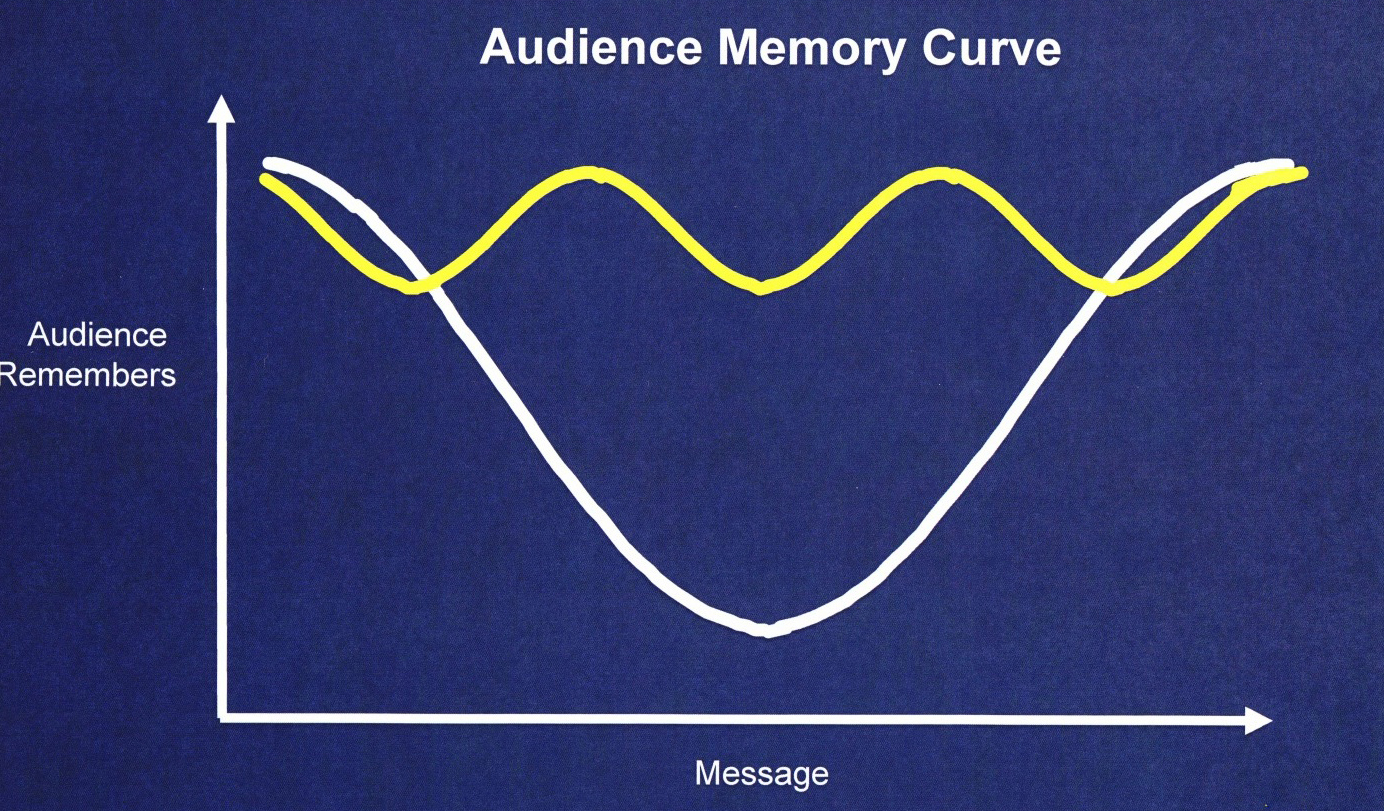
Memory Curve: People are paying most attention at the beginning and end of a message, and so tend to not remember and understand material presented in the middle of a presentation. Make you openings and closes count, and break up long chunky sections.
Tuesday, April 7, 2020
Wednesday, January 15, 2019
Clips used in Class 3
Terms You Should Know:
Reactive: Solving a problem in such a way as to return to the status quo ante. (Status quo ante means 'the way things were before'.
Proactive: Solving a problem in such as way as to go beyond the status quo ante by flipping problems into opportunities.
Credibility: It means 'believability'. It's the measure of the audience's receptivity to your message. People with low credibility can have great ideas for which audiences will have little receptivity, and people with high credibility will find audiences accepting even silly or stupid ideas.
Primary Audience - Secondary Audience: You design your message to obtain a thinking, feeling, or action response from your primary audience; you don't expect a response from your secondary audience. The secondary audience can be people you send the message to, as in a cc, and it can be anybody who reads the message whether you intend them to read it or not.
Primary Objective - Secondary Objective: The primary objective is reactive; it's about putting out the fire. The secondary objective is proactive; it's about looking for ways to go forward once the fire has been put out. Every message has a primary objective; not every message has a secondary objective. In my revision of the Goodwin message (see below), I make clarifying the misunderstanding the primary objective. The secondary objective is to sell him an overdraft line of credit or perhaps have him consolidate accounts with my bank. The original messages 1 & 2 had no secondary objectives.
Prepositions and Prepositional Phrases: Prepositions introduce phrases that play a modifying or descriptive function in a sentence, the way adjectives and adverbs do. In the sentence 'The dog under the table' is chewing a bone. The preposition is 'under' and the prepositional phrase is 'under the table'. The prepositional phrase plays the role of an adjective here. It's as if you're saying 'The under-the-table dog is chewing a bone'. Prepositional phrases always have objects, and when those objects are pronouns, they are in the accusative form: 'under him', 'between you and me'.
Tactical Flaw: (Aporia, Dubitatio): Presenting oneself as having weaknesses or peronsal flaws, or being ignorant or in a state of doubt, in order to create a space for your audience to become more engaged or to take more responsibility. Use it to lower expectations or to take a more human, humble stance before your audience, especially if you are perceived by it as arrogant or successful. Clooney Character: "i'm not really the one you would ordinarily talk to about things like this, but . . ." In Al Pacino clip shown in Class 3?
Tactical Concession: In an argument or attempt to persuade, a move to give up a short-term advantage in order to procure one that is long-term. Instead of challenging your opponent's facts or assumptions, you concede that he is right. This has a disarming effect, and makes him feel that he has been heard and is well understand.
Thursday, April 2, 2020
Links to Class 2 movie clips:
- Tobacco Industry front man
- Clooney confronts his brother-in-law-to-be
- Newman confronts Nurse in The Verdict
Memo Punctilio Assignment
Analysis Hints: Use the Situation Analysis form at the top of the column to the left, and just fill in the blanks. Don't worry if parts of it don't make sense. I'll explain it next class.
- When you are trying to define the issues, look at them in this case as being arranged concentrically, with some issues more at the periphery influencing the most important issue in the center. Which one is the crux?
- When defining objectives think about them in two categories: reactive--what you have to do at a minimum to put out the metaphorical fires--and proactive--what possibilities are there to go beyond the status quo ante.
- When defining the audience, the most important element is to define the audience's need, because what you choose to include in your summary should be determined by its usefulness in meeting your boss's need.
Remember, your goal in this assignment is to create a document that will be more useful or helpful for your boss than the original article.
***
Here's the table I promised to post on Thursday:
Person Nominative(subjects)
Accusative(objects)
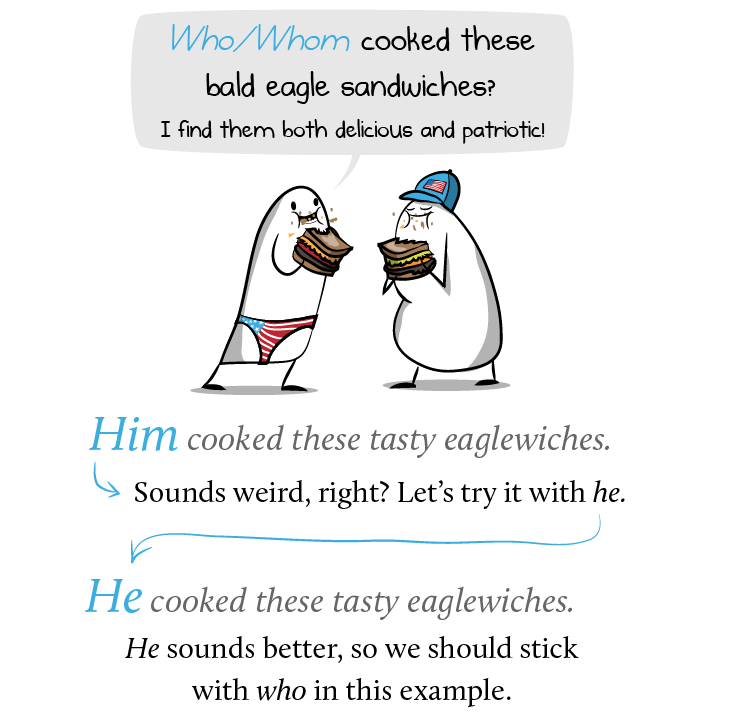
1st Person I, we me, us 2nd Person you you 3rd Person he, she, it, they him, her, it, them relative pronoun who, whoever whom, whomever You can practices the three-step who/whom process taught in class by going here and here. Use all three steps when you practice:
- Bracket the dependent clause that follows the who/whom.
- Insert a pronoun into the dependent clause that makes it into a complete sentence.
- If the case of the pronoun is nominative, use who; it the case is accusative, use whom.
More on who/whom:
(Source)
Go the source link for more on these other uses of who and whom. These rules are fine for when you have a who or whom that begins a sentence (or is used in any other role except introducing a dependent clause), but you have to use my three-step method when a who or who is a relative pronoun introducing a dependent clause. You might otherwise be misled to think that it would be ok to say "Give the prize to whomever you think deservers it." Give the prize to him, right? No.It's not right.
***
Goodwin Revision
Dear Mr. Goodwin:
I am writing in response to your August 15 email questioning the $108.00 in overdraft fees charged against your account. After receiving your email we investigated to learn why you were charged, and we learned that a miscommunication between you and the United Oregon Bank led to the imposition of this fee.
In your email, you mentioned that you had instructed the United Oregon Bank to transfer $45,000 to your account here on August 1. It did not, however, make the transfer until August 10--which explains why on August 8 we charged your account for the overdraft.
We value your account with us, Mr. Goodwin. You have been one of our most reliable and valued customers, and we understand that miscommunications like this happen from time to time. On this occasion we are happy to refund to you the $108. But please contact United Oregon to be sure that they send future transfers on the date you specify.
Perhaps an overdraft line of credit would be appropriate if you anticipate this kind of miscommunication in the future. You might also consider consolidating your accounts in such a way as to make these transfers unnecessary.We’ll have one of our personal bankers contact you in the next week to see if we can help you to meet your banking needs in a more streamlined way.
Sincerely,
Note that this revision makes the misunderstanding issue the "crux", and adds a proactive dimension by seeking to flip the problem into an opportunity and move with Mr. Goodwin beyond the status quo ante.
***
Terms You Should Know:
Extrinsic motivation: Carrots and sticks, desire and fear--the promise of reward or the threat of punishment from a source outside of oneself. Extrinsic because you need some kind of external positive or negative stimulation to motivate you to act.
Intrinsic motivation: Autonomy, mastery, and purpose. Intrinsic because they are motivators that arise from within the person without external stimulation. Intrinsically motivated people do what they do because they have an internal drive that works independently from the crowd, that wants to improve their skills, or because of ideals or internal desires that are meaningful to them.
Clause: A verbal construction that comprises both a subject and a verb. They come in different varieties. You need to understand the difference between an independent and dependent clause.
Nominative: Case for nouns and pronouns that function as subjects in clauses.
Accusative: Case for nouns and pronouns that function as objects of verbs and prepositions.
Crux: The core energy center of your message. Your message might have a lot of parts to it, but there is almost always one part that is more interesting and more important. That's where the energy is. In the Goodwin messages the energy for message 1 focused on the 'angry customer issue'; message 2 focused on the 'future accountability issue'. The approach here would have been better if it focused on the 'misunderstanding issue'.
Tuesday, March 31, 2020
Except for some problems with showing the full browser page in my 830 section, the first experiment with Zoom went pretty well today. And it will get better as we go along.
For those of you who missed the class today, here is a link to a recording of the 1030 section. I will only post one recording, since the lectures are essentially the same for all the sections.
If you have questions, problems, suggestions, the best way to communicate with me between classes is through email. I check fairly regularly during the day.
A reminder that to prepare for class Thursday, you should have read Chapter 1 in PTO (Woe Is I), and have watched the video posted below by Dan Pink. Take notes and be ready to discuss.
Monday, March 23, 2020
Welcome to Strategic Communications for Spring Quarter 2020. I'll be using this space as the quarter progresses to summarize and amplify points that I make in class with verbal commentary, video, and other supplementary materials. Check in at least once a week to make sure you're up to speed.
It will probably take me until the week before classes begin to get all the relevant links updated, but you can explore the ones that are live now if you want to get a feel for the resources available here.
The assignment links will be activated the class day I introduce the assignment. Even if you miss class, you should know what the assignment is.
***
For Class 2, watch the Dan Pink video below, and be prepared to talk about the difference between extrinsic and intrinsic motivation and why intrinsic motivation is critical to any kind of highly cognitive or creative work.
Terms you should know:
Ethos--the values world that shape what is acceptable or unacceptable behavior and attitudes. One is ethical or unethical, admired for ones virtues, or shamed for one's vices depending on the ethos of a group. What is virtue for the mafioso is vice for the law-abiding citizen.
Commonplace--values and 'truth' accepted by a community without question or critical analysis. It's just true that the early bird gets the worm, right?
Style--The lens through which the substance of your message is projected. Ideally it should enhance the effectiveness of your message, but often it distorts and obscures it.
Yin--a style that is cool, indirect, subtle, complex, sometimes mysterious or seductive. It's the jazz musician with the soft voice and the mirror sunglasses. Academic style has a bias toward the yin.
Yang--a style that is warm, direct, obvious, accessible. It has strong signal and minimal noise. It's the drill seargeant shouting at a recruit. Business style has a bias toward the yang.
Exposition--Content in a message that is primarily informational, the facts without interpreting them. It's the data dots required to be connected when you want to deliver an insight.
Insight--the experience of "getting it". A common example is getting a joke or any time you get a satisfying answer to a question or solution for a problem. It's when you see the pattern that connects the dots.
Relaxed intensity--The ideal stance any performer takes during a performance. It comprises both a loose, comfortable body posture at the same time as having a mindset that is highly focused and committed to performing the task at hand.
Zoom Recordings
Class Slide PDFs
Film Clips
- Pink on Motivation
- Tobacco Industry front man
- Clooney confronts his brother-in-law-to-be
- Newman confronts Nurse in The Verdict
- Whomever at the Office
- Chocolate or liberty?
- Pacino in the locker room
- Vinnie in the Courtroom
- Leading like a Swan
- Do it for your kids, Bob
- High Five Etiquette
- Lose the Jewelry
- Do it for your kids, Bob
- Gecko Greed speech
- Team Strategy
- Susan Cain Podcast
- Warning label on cheese
- Jason Street
- Old North Face
- Kawasaki on Mantras
- Stoudamire
- Stadium Tablet
- Bluto and Leadership
- Otter in court
- Nancy Duarte
- Dick Hardt, "Identity 2.0"