JEFFREY L. SCHWARTZ
Education
Research Interests:
- Low Dose Radiation Effects
- Long Term Response to Radiation Therapy
- PET-Based Tracers of Tumor Response to Therapy
|
Ongoing
Research Projects:
PET-Based Tracers of Tumor Cell Proliferation
Preclinical and patient evaluation studies have established the potential of 3'-deoxy-3'-[F-18] fluorothymidine (FLT), a thymidine (TdR) analog, as a positron emission tomography (PET)-based measure of tumor cell proliferation that can provide information on tumor response to cancer therapy in vivo. The use of FLT as a surrogate for tumor proliferation is based on two assumptions. The first is that thymidine kinase-1 (TK1, a cytosolic enzyme) activity is the primary factor driving FLT uptake and retention in tumors. The second is that TK1 activity is selectively expressed or up-regulated in proliferating cells. Our in vitro studies have shown that neither of these assumptions is always correct. FLT uptake and retention is not solely a reflection of TK1 activity. There are other cell processes that can influence the kinetics of FLT uptake and loss from cells, many of which may be altered in tumor cells. Our studies also demonstrate that TK1 activity can be elevated in noncycling cells due to loss of cell cycle checkpoint control, another cell response often altered in tumor cells. In order to realize the full potential of FLT, it is necessary to understand all the major factors that might affect its transport and retention in tumors. To accomplish that goal, we are examining the role of nucleoside transporter levels, cell cycle checkpoint control integrity, de novo nucleotide biosynthesis activity, and the presence of nucleotide efflux transporters on the relationship between tumor cell proliferation and FLT transport/retention in tumor cells. The results from this study will provide laboratory validation of the factors that influence transport and retention of FLT, FMAU, and, by extension, other nucleoside tracers, in tumor cells both before and after cytotoxic/cytostatic treatments. In addition, this study will address the potential benefit of dynamic versus static tracer image analysis in evaluating tumor cell proliferation and response to therapy. Our long-term goal is to develop a simplified and clinically feasible approach to quantify FLT uptake that is based upon detailed knowledge of FLT kinetics and factors that affect kinetics.
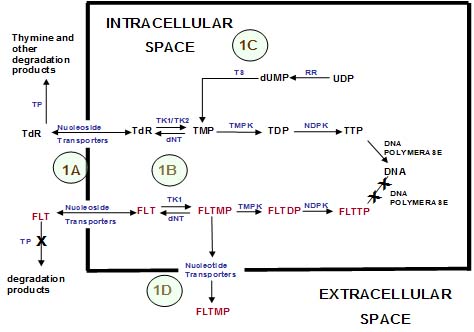
Proposed Metabolism of TdR and FLT |
Role of Bystander Effects and Adaptation in Individual Radiation Response
The main hypothesis of this proposed work is that the ability to release or respond to bystander (nontargeted) effectors as well as the capacity for adaptation (induced resistance) are major modifiers of inherent sensitivity to ionizing radiation. Bystander effects are defined as nontargeted effects, where unexposed cells are affected by nearby exposed cells. The adaptive response is defined as low dose (<10 cGy) radiation-induced resistance to subsequent exposures. Both phenomena have been extensively studied, but questions remain as to their underlying mechanism, their contribution to interindividual variations in radiation response, and especially, their influence on risk estimates for radiation-induced cancer. Our preliminary studies suggest a link between bystander and adaptive responses. Our observations lead us to the hypothesis that both phenomena are important modifiers of inherent sensitivity to ionizing radiation.
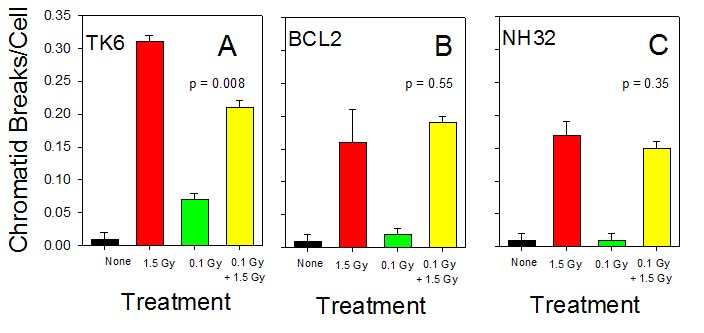
Induction of Adaptive Responses in Different Lymphoblastoid Cell Lines |
Radiation-Induced Genome Instability
Ionizing radiation is a known mutagen and carcinogen. While the mechanisms for mutation induction are relatively well understood, the mechanisms for cancer induction remain to be elucidated. A lack of understanding of the radiation carcinogenesis process makes it difficult to define risks from radiation exposure and to develop appropriate countermeasures. One likely mechanism for radiation carcinogenesis is through the induction of genetic instability. It is well established that radiation exposure will increase baseline mutation rates, and that elevated mutation rates can lead to cell transformation and oncogenesis. Our studies have focused on understanding the mechanism for induced genetic instability, initially studying cytogenetic changes and more recently gene copy number changes. We have observed that radiation exposure will increase frequencies of chromosome telomere fusions and produce non-random patterns of copy number alterations as measured by microarray CGH (array CGH). The goals of this project are to continue to study these changes and elucidate the processes that lead to specific types of genetic instability. Understanding the relationship between genotype/phenotype and radiation-induced instability characteristics might provide important leads for fine-tuning risk estimates to individual and tissue-specific variations in radiation response. |
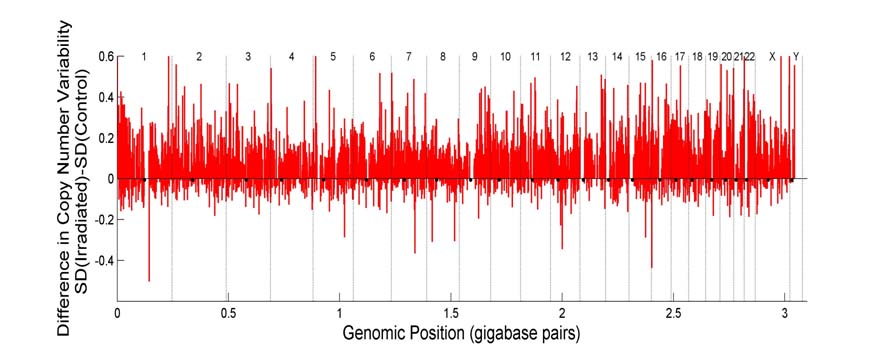
Genome-wide DNA copy-number variability resulting from chronic, low-dose irradiation of TK6 clones. Plotted are the differences in SD of log(FR) between nine irradiated and nine unirradiated TK6 clones at 7,045 mapped loci. Positive values indicate greater variability for irradiated clones and negative values mark loci for which variability was greater in non-exposed controls. Log is base 2. SD, standard deviation. FR, fluorescence ratio. Chromosome numbers are marked above respective genomic segments, which are separated by dashed lines.
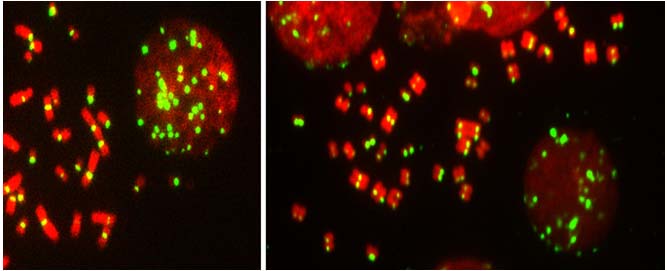
Examples of radiation-induced chromosome instability. Cells are stained with a centromere-specific probe to illustrate dicentric chromosome formation. |
Recent Publications:
Connolly, L., M. Lasarev, R. Jordan, J. L. Schwartz and M. S. Turker. Atm Haploinsufficiency Does Not Affect Ionizing Radiation Mutagenesis in Solid Mouse Tissues. Radiation Research 166:39-46 (2006).
Schwartz, J. L. Variability: The common factor linking low dose-induced genomic instability, adaptation and bystander effects. Mutation Research 616:196-200 (2007).
Baliga, M. S., H. Wang, P. Zhuo, J. L. Schwartz and A. M. Diamond. Selenium and GPx-1 overexpression protect mammalian cells against UV-induced DNA damage. Biological Trace Element Research 115: 227-242 (2007).
Schwartz, J. L., R. Jordan, J. Slovic, A. M. Moruzzi, R. R. Kimmel and H. L. Liber. Induction and loss of a TP53-dependent radioadaptive response in the human lymphoblastoid cell model TK6 and its abrogation by BCL2 over-expression. International Journal of Radiation Research 83:153-159 (2007).
Zhang, X-B, J. L. Schwartz, R. K. Humphries, and H-P Kiem. Effects of HOXB4 overexpression on ex vivo expansion and immortalization of hematopoietic cells from different species. Stem Cells 25:2074-2081 (2007).
Leisenring, W., D. L. Friedman, M. E. D. Flowers, J. L. Schwartz and H. J. Deeg. Non-melanoma skin and mucosal cancers after hematopoietic cell transplantation. Journal of Clinical Oncology 24:1119-1126 (2006).
Grierson J. R., J. S. Brockenbrough, J. S. Rasey, L. W. Wiens, J. L. Schwartz, R. Jordan, and H. Vesselle. Evaluation of 5'-deoxy-5'-[F-18]fluorothymidine as a tracer of intracellular thymidine phosphorylase activity. Nuclear Medicine and Biology 34:471-478 (2007).
Kimmel, R.R., Agnani, S., Yang, Y., Jordan, R., and Schwartz, J.L. Copy-Number Instability in Low-Dose Gamma-Irradiated TK6 Lymphoblastoid Clones. Radiation Research 169:259-269 (2008).
Wolf, N., W. Pendergrass, N. Singh, K. Swisshelm and J. Schwartz. Radiation cataracts: mechanisms involved in their long delayed occurrence but then rapid progression. Molecular Vision 14: 274-285 (2008).
Li, H., N. Liu, G. K. Rajendran, T. J. Geron, J. Rockhill, J. L. Schwartz and Y. Gu. A Role for Endogenous and Radiation-Induced DNA Double-Strand Breaks in p53-Dependent Apoptosis during Cortical Neurogenesis. Radiation Research 169:513-522 (2008).
Schwartz, J. L., K. J. Kopecky, R. W. Mathes, W. M. Leisenring, D. L. Friedman, and H. J. Deeg. Basal Cell Skin Cancer Following Total Body Irradiation and Hematopoietic Cell Transplantation. Radiation Research 171:155-163 (2009).
Research Society Links