


| Reading: | Lecture Notes, Chapter 7, pages 1-15; |
| Efron and Tibshirani, Chapter 4 (pages 31-37), Chapter 21, pages (296 - 205). | |
| Due: | Wednesday, May 24, 2000. |
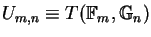 where
where
 is the Mann-Whitney functional
and
is the Mann-Whitney functional
and  and
and  are the empirical df's of
 i.i.d. with df F,
 i.i.d. with df G.

 and that
![\begin{eqnarray*}Var( \sqrt {mn} U_{m,n} )
& = & (n-1) \int (1-G)^2 dF + (m-1)\i...
...] +(m-1)Var[F(Y)] \\
& & \qquad + \ \int FdG (1-\int FdG ) \, .
\end{eqnarray*}](img9.gif)

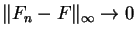 and
and
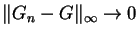 ,
then
,
then
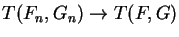 .
.
 .
.
 .
.
 of distribution functions
F on R+ with
of distribution functions
F on R+ with
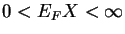 and
and
 .
Let
.
Let
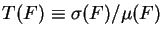 for
for
 where
where
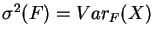 and
and
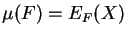 .
This is the coefficient of variation of F.
Find the influence function of T(F).
.
This is the coefficient of variation of F.
Find the influence function of T(F).
is the same class of distribution
functions as in problem 1, but now consider the functional
T(F) defined for a fixed
 by
by

 be the correlation coefficient
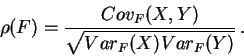
 of distribution functions on R2 so
that
of distribution functions on R2 so
that  is weakly continuous on .
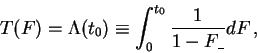
 of T(F)?
Can you prove asymptotic normality of
directly?
of T(F)?
Can you prove asymptotic normality of
directly?