next up previous
Next: About this document ...

MATH/STAT 394: Probability I
Wellner, 1/3/2000


Math Diagnostic Quiz Solutions


1.
$1 + 2 + 3 + \cdots + 30 = \frac{30\cdot 31}{2} = 465$
2.
$1 + 2 + 3 + \cdots + m = \frac{m(m+1)}{2}$; see Kelly, A.5.1, page 575.
3.
$1 + \frac{1}{3} + \frac{1}{9} + \frac{1}{27} + \frac{1}{81} + \cdots =
\frac{1}{1-1/3} = \frac{3}{2} $
4.
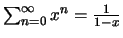
$\sum_{n=0}^{\infty} x^n = \frac{1}{1-x}$ for |x|<1; see Kelly, A.5.8, page 576.

5.
$\int_1^2 x^3 dx = \frac{1}{4} x^4 \big \vert _1^2 = \frac{1}{4} (16 -1)
= \frac{15}{4}$
6.
$\frac{d}{dx} (x^2 \log x) = 2 x \log x + \frac{x^2}{x} = 2 x \log x + x$
7.
$\frac{d}{dx} (\cos(x^3)) = - \sin(x^3) 3x^2$
8.
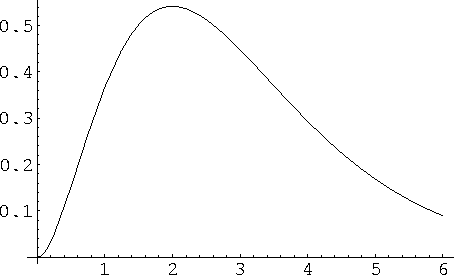
Sketch the graph of the function x2 e-x for x > 0 and find its maximum value. Solution: With g(x) = x2 e-x, we find that g'(x) = 2x e-x + x2 e-x = x e-x (2 -x) = 0 if x =2, while

g''(x) = (2 - 2x) e-x - x(2-x) e-x = (x2 - 4x +2) e-x

has g''(2) = (4-8+2)e-2 = -2 e-2 < 0. Thus g has a maximum at x=2. Also g(0) = g'(0) = 0, and $g(x) \rightarrow 0$ as $x \rightarrow \infty$. Thus the picture of g is as follows: (see next page).
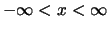

  
Figure: Plot of x2 e-x.
\begin{figure}\hspace{1.7cm}
\epsfysize=3in
\epsfxsize=4in
\epsfbox{fig1.eps}
\end{figure}

9.
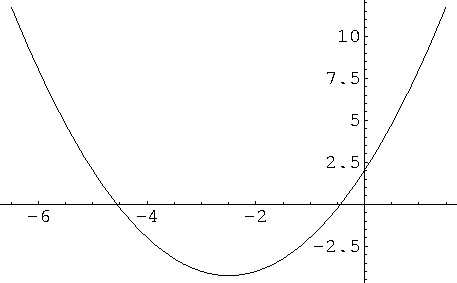
Sketch the graph of the function f(x) = x2 + 5x +2 for $-\infty < x < \infty$, find its minimum value, and find the roots of the equation f(x) = 0. Solution: f'(x) = 2x +5 =0 if x = -5/2, and

\begin{displaymath}f(5/2) = \frac{25}{4} - \frac{25}{2} +2 = - \frac{17}{4} \, .
\end{displaymath}

The roots of f(x) = 0 are given by

\begin{displaymath}x_{\pm} = \frac{-5 \pm \sqrt{25- 8}}{2} = - \frac{5}{2} \pm \sqrt{17/4} \, .
\end{displaymath}

Thus the picture of the function f is as follows:
  
Figure: Plot of f(x) = x2 + 5x +x.
\begin{figure}\hspace{1.7cm}
\epsfysize=3in
\epsfxsize=4in
\epsfbox{fig2.eps}
\end{figure}

10.
$\int_0^1 \int_0^1 x^2 dx dy = \int_0^1 \frac{1}{3} x^3 \big \vert _0^1 dy
= \int_0^1 \frac{1}{3} dy = \frac{1}{3}$
11.
Let T be the triangle with vertices (0,0), (1,0), and (1,1) in the x-y plane. Then

\begin{displaymath}\int\int_T y dx dy = \int_0^1 \int_0^x y dy dx = \int_0^1 \frac{1}{2} x^2 dx
= \frac{1}{6} \, .
\end{displaymath}

See Kelly, A.9.1, page 584.
12.
How many distinct unordered subsets can be formed from $\{ 1, 2, \ldots , n \}$, including the empty set? Solution: 2n (see e.g. Kelly, Corollary A.4.2, page 572).
13.
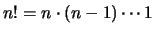
In how many distinct ways can the integers $1, \ldots , n$ be arranged? (i.e. how many permutations?) Solution: $n! = n \cdot (n-1) \cdots 1 $ (see e.g. Kelly, A.4.4, page 572).

 
next up previous
Next: About this document ...
JON Wellner
2000-01-03