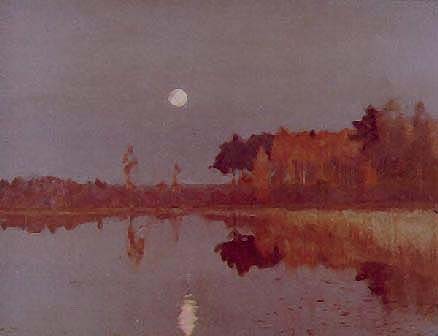
 The trees reflected in the river in the left middleground of Khrutsky's view are a long-standing cliché of landscape painters. There are unusually many examples in Russian landscapes from the mid-nineteenth century onwards, often with the reflection playing a major role in the composition, which would suggest that the Russian painters made this device in some sense their own. Metaphorically, it is a complex and fascinating device. In a landscape that derives its depth from a view across water to forested land in the middle distance, it lends an ethereal character. In pictorial contexts where the reflection of the sky in the water suggests a mingling of heaven and earth (a common metaphorical reading of such landscapes), reflected trees heighten this effect by engaging with the reflected sky. The top left image is Isaak Levitan's Twilight. Moon (1899) in which the half-light between day and night, a commonplace Romantic philosophical image, reinforces the metaphorical meaning.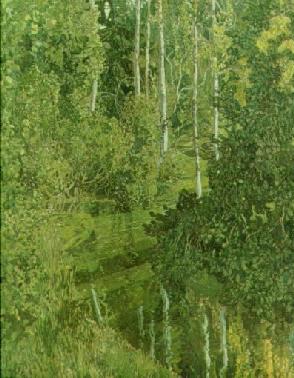
Click on either image on this page to enlarge it.
Most often the reflection of trees in an expanse of water is a feature of extensive landscapes. In Russia, the exploration of the forest scene led to the appearance of this feature in intensive landscapes, where water is tightly hemmed in by trees, but the reflection of the trees seems to give the forest another dimension. On the right is a particularly striking example, Aleksandr Golovin's Forest River. Here the river blends almost indiscernibly into the forest by reflecting its foliage, but the reflection of pale tree-trunks in the foreground breaks the illusion and reveals an inverted forest in the river. The intensive landscape is unexpectedly opened up, giving the scene a mysterious depth. As the mathematics textbooks put it, how to read such a landscape is "left as an exercise for the reader." It is clear at least that it contains some pictorial rhetoric, which is even to be expected: Golovin was best known as a designer of stage sets, where his flair for dramatic statement found its outlet.