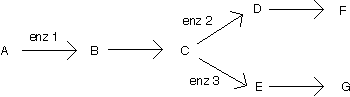
Regulation of branched biosynthetic pathway. The objective is to regulate the flow of carbon from compound A (see below) to the final endproducts F and G. Problem, what if F or G is in excess need for biosynthesis, how does cell reduce flow of carbon through one pathway without effecting other pathway?
Sequential feedback inhibition: endproduct F could feedback inhibit the first enzyme of pathway committed to synthesis of F, enz 2, thus reducing flow of carbon from C to F without effecting flow of carbon from C to G. If G increases, it could feedback inhibit enz 3 which would reduce flow of carbon from C to G. If stop flow of carbon from C to F and G, intermediate C would increase and it could inhibit the first enzyme of pathway, enz 1, which would cess flow of carbon through this pathway.
Isofunctional enzyme inhibition: same as above except that have two enzyme 1's, that catalyze the same reaction, but each sensitive to feedback inhibition by different endproducts. For one enzyme the allosteric effector is F and for the other G. So that as F and/or G increase could regulate each committed pathway, and reduce/stop flow of carbon from A to C.
Concerted feedback inhibition: In concerted feedback inhibition, have only one enz 1, and enzyme has two allosteric sites (one for F and one for G). To stop flow of carbon from A to C both need to be bound to enz 1. Enz 2 and 3 still regulated by their respective endproducts.
Cumulative feedback inhibition: In cumulative feedback have only one enz 1, and two allosteric sites, but as each endproduct binds activity of enzyme is reduced by 1/2. Thus, to get complet inhibition both endproducts must be associated with enzyme. In case of glutamine synthetase, enzyme has 96 allosteric sites, and the binding one allosteric effector reduces enzyme acitivity by 1/96.
Inhibition plus activation: Not all endproducts are negative feedback inhibitors. Some endproducts can bind to enzyme and "activate" enzyme, i.e, increase its affinity for substrates. See bottom right of handout provided in class.