Why are nonlinear equations important?
Most of us were introduced to mathematics by solving linear equations. We obtained analytical solutions that can be represented by well-known functions, such as polynomials, exponential functions, sines or cosines (which have to be tabulated), Bessel functions, error functions, and so forth. In engineering studies, the linear problems provide great insight into some phenomena, but only up to a point.
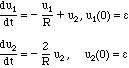
Consider the following linear problem.
It is possible to solve this equation analytically.
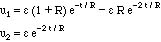
The norm of the solution

is plotted in the figure. Note that the curves are all parallel to each other, and only displaced up or down depending on the initial condition. This is a result of the fact that it is a linear problem.
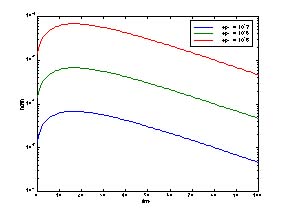
Analytic solution to linear problem, eps = 10-7, 10-6, 10-5
Next consider the more general problem.
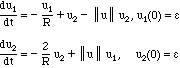
where

is the norm of the solution. If the norm of the solution is small enough, the problem is the same as the linear problem shown above. Indeed, the solution is identical, as shown below.
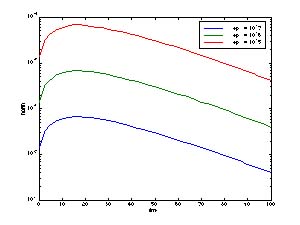
Numerical solution to linear problem, eps = 10-7, 10-6, 10-5
But, look at what happens when the initial condition is increased.
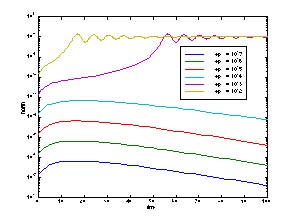
Numerical solution to nonlinear problem, eps = 10-7, 10-6, 10-5, 10-4, 10-3, 10-2
Now the solution is very different, and the curves for an initial condition ten times larger are not just the same solution multiplied by ten. This is a fundamental characteristic of nonlinear problems. If one variable, u1, is plotted versus the other, u2, we get an interesting pattern.
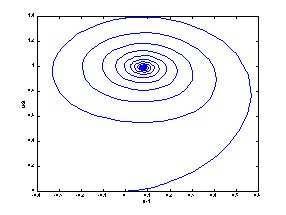
Phase-plane plot of solution to nonlinear problem, R = 25, e = 10-2
In fact, this is a simple model of fluid turbulence, and the parameter R is a stand-in for Reynolds number.
Most of the real world is governed by nonlinear problems. Yet, very few of them have analytical solutions. What to do? We solve them numerically. Then, however, we have two other tasks: we have to (1) prove that we've solved the right problem and (2) identify the error in the numerical solution, which is only an approximation. Thus, in return for a broader application of our skills, we have some additional tasks. This book emphasizes techniques that help you meet these goals. Since an observer can look at an analytical expression and determine that it solves a specified equation, but we can't do that with a numerical solution, we have to verify and justify our work some other way. An observer can't be sure of the numerical error, either, unless we determine what it is.
This book gives you the knowledge and techniques that will enable you to solve nonlinear problems using either general purpose computer programs and/or code you have written to interact with numerical analysis programs. The goal is that you can do that faster, better, and cheaper than was possible even twenty years ago.
Take-Home Lesson: Nonlinear problems are usually solved numerically. Thus, we have to learn how to verify our work and specify the maximum error in the numerical solution.