|
1
|
|
|
2
|
- Different Competitive Environments
- Traditional market trajectories
- Technology or knowledge markets
- Competitive Implications
- Strategic Implications
- Innovation: The Track Record
- Areas for Study
|
|
3
|
- The Protected Market
- National Oligopoly
- High Entry Barriers
- Government Regulation
- Competitive Advantage from Market Power
- Limited Price Competition
- Non-Price Competition
- High Profits
- Incremental Innovations (Not Rule Breaking)
- Equilibrium Conditions Prevail
|
|
4
|
- The Protected Market: Examples
- Autos & Steel in 1950s and 1960s
- Airlines Prior to 1979
- Electric Utilities until 1991
- Computers in 1960s and 1970s
- Telephone Services until 1970s
- Pharmaceuticals until 1980s
|
|
5
|
- The Competitive Market
- More Fragmented Market Structures
- Lower Entry Barriers
- Competition on Price and Perceived Quality
- Lower Industry Profits
- Competitive Advantage from Productive Efficiency
- Incremental Innovation
- Episodic Quantum Innovation
- Rule Breaking
- Punctuated Equilibrium
|
|
6
|
- The Competitive Market: Examples
- Airlines in 1980s and 1990s.
- Electric Utilities in 1990s
- Steel in the 1970s and 1980s.
- Autos 1973-1985
- Soft Drinks 1977-1985
- Telephone Services 1980s and early 1990s
- Pharmaceuticals 1980s onwards
|
|
7
|
- The Hypercompetitive Market
- Continual Innovation Drives Competition
- Innovation is Multifaceted
- Products, Processes, Strategies, Structures
- Incremental and Quantum Innovation are Commonplace
- Creative Destruction
- Disequilibrium Conditions Prevail
- Price and Quality Play a Supporting Role
|
|
8
|
- The Hypercompetitive Market
- Entry Barriers Unsustainable
- Imitation is Rapid
- Market Power is an Illusion
- Productive Efficiency not Sufficient for Survival
- Competitive Advantage from…
- Innovative Efficiency
- Adaptive Efficiency
- Productive Efficiency
|
|
9
|
- The Hypercompetitive Market: Examples
- Computers and Peripherals After 1981
- Retailing in the 1980s and 1990s
- Automobiles from 1985 onwards
- Telephone Services mid 1990s onwards (hah!)
- Pharmaceuticals late 1990s?
|
|
10
|
- 1917 Forbes 100 published
- 1987 39 still existed
- 18 still on Forbes 100
- 2 performed better than the market over the period
- S&P 500 in 1957
- 1997 74 remained
- 12 outperformed the index
- Group performance 20% less per year than S&P 500
|
|
11
|
|
|
12
|
|
|
13
|
- Increasing efficiency of business
- Increasing efficiency of capital markets
- Globalization and deregulation of markets
- Fragmentation of Markets
- All lead to: Increased Competitive Pressures
|
|
14
|
- Accelerating pace of technological change
|
|
15
|
- Accelerating Pace of Technological Change
- Surge in Base Technologies with Wide Application
- Microprocessors, Software, Fiber Optics, Biotechnology, Composite
Materials, Nanotechnology
- “Creative Destruction”
- Innovation Creates New Opportunities and Destroys Old Positions
- Which leads to :Increased Competitive Pressure
|
|
16
|
- Distinction between physical products and technology is not always easy
to make
- Blueprints
- There’s a clear line between the product and the technology.
- Technology can be embodied in the physical artifacts .
- Method for screening biological compounds can be embedded in a chip.
- Algorithms in software, Purchase of the software includes the right to
use the embodied knowledge -so software is usually licensed rather
than sold.
|
|
17
|
|
|
18
|
- Increased Importance of Innovation
- No Sustained Advantage
- No Safe Profit Fortresses
- Shorter Product Life Cycles
- Smaller Market Niches
- Increase in Break-even Market Share
|
|
19
|
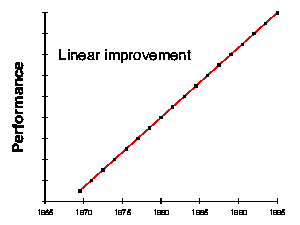
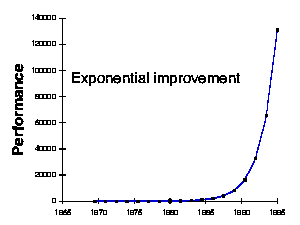
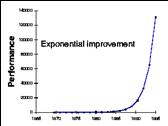
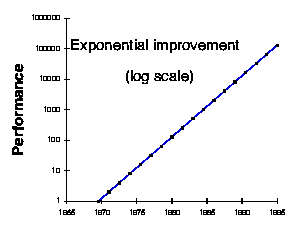
- The phenomenon of exponential progress Every year or two, the amount of
processing speed you can buy for a dollar doubles ... Every year or two,
the amount of memory you can buy for a dollar doubles
- It's been going on for several decades
- It's likely to keep going on for at least one more
|
|
20
|
|
|
21
|
- Pioneers' covered wagon: 20 miles a day
- Early automobiles: 20 miles an hour
- Supersonic aircraft: 20 miles a minute That's a factor of 1000.
Squeeze that into 10 or 15 years.
That's how fast information technology is moving.
|
|
22
|
- If, over the past 30 years, transportation technology had improved at
the same rate as information technology with respect to size, cost,
performance, and energy efficiency, then an automobile would ...
- be the size of a toaster
- cost $200
- go 100,000 miles per hour
- travel 150,000 miles on a gallon of fuel
|
|
23
|
|
|
24
|
- Advantage Goes to the Innovative
- Where and How R&D is Spent Matters
- Cycle Time is Important: Quick Innovators….
- Amortize Fixed Costs Before Next Generation
- Capture First Mover Advantages
- Experience Curve, Brand Loyalty, Pre-Emption…
- Establish Standards
- Dominant Design and Network Externalities
- Experiment
- Economize on Development Costs
|
|
25
|
|
|
26
|
- Failed Product Introductions are Expensive
- Maximize Fit with Customer Requirements
- In Addition to Speed of Development..
- Quality Matters (TQM, etc…)
- Features Matter (Match Customer Demands)
- Maximize Ability to Produce
- Production Costs Matter
- Ability to Execute Production Ramp up Matters.
|
|
27
|
- Product Launch Strategy is Critical
- Producing Product only Half Task
- Maximizing Market Penetration Important
- Depends on Collaboration Strategy..
- Licensing, Alliances, Go it Alone.
- Depends on Positioning Strategy
- Pricing, Promotion, Distribution, Product Functionality
|
|
28
|
- Age of discontinuity
- Corporations’ survival goal is continuity
- Cultural “lock-in”
- Evolve into entities of convergent thinking
- Discontinuity thrives on divergent thinking
- May use private equity or venture as future models for corporations
|
|
29
|
- Competition in Technology Driven Industries
- Relationship Between Tech Change and Competition?
- Technology Strategy
- How to Make Appropriate R&D
Investments?
- Product Development Process
- How to Simultaneously:
- Minimize Time to Markets, Maximize Fit with Customer Requirements
& Ability to Produce?
- Product Launch Strategy
- How to Maximize the Probability of
Success?
|
|
30
|
- Dominant Design
- The Evolution of Competition
- Network Externalities
- Technology Paradigm Shifts
|
|
31
|
- Technology-based industries tend to be characterized by a dominant
design.
- Dominant Design……
- A range of basic choices about a design that are not revisited in every
subsequent design
- Model T
- AC power system
- Quartz watches
- TCP/IP
- TV: PAL, SECAM, NTSC
|
|
32
|
- How does a dominant design occur?
- By exclusion and synthesis
- Not in a pre-determined way
- A “satisficer”; Not necessarily optimal
- Emerges from
- Problem-solving in the design stage
- Some core concept narrow the product design criteria
|
|
33
|
|
|
34
|
|
|
35
|
|
|
36
|
- Embryonic Stage
- Fluid
- Lots of experimentation
- Period of rapid learning
- Standards wars
- Wireless: AMPS, GSM, TDMA, CDMA
- PCs: C/PM, Apple, DOS, Tandy, DEC
- Uncertainty About Future Standard
- Huge technical and market risk
- Feature and product-based competition
|
|
37
|
- Transitional Stage
- Dominant Design Emerges
- Competition Centers Around Perfecting Design and Reducing Prices
- Favors firms with better technical and engineering skills
- Attention Shifts to Process Innovation
- Goal: Drive Down Cost of Producing Dominant Design
- PCs in early 1990s
- Competition population curve peaks
- Industry consolidates around most efficient producers
|
|
38
|
- Mature Stage
- Both Product & Process Features Standardized
- Market an Oligopoly: “Rule of three”
- Back to incremental innovation
- Period of incremental innovation broken by next technological
discontinuity
- New technology emerges to supplant previous one
- Transistors over vacuum tubes
- Wireless over wireline?
|
|
39
|
|
|
40
|
- Product Life Cycle and Product Applications
|
|
41
|
- As Product and Process Technology Matures
- Performance/Price Ratio Becomes Favorable
- Applications of Technology Widen
- Example: Carbon Fiber
- Specialty Applications - Aerospace
- Broad Applications - Automotive, Transportation.
- Example: Satellite Positioning Devices
- Specialty Applications - Military, Commercial Marine
- Broad Market - Outdoor Sports, Auto Navigation
- Fortunes Made Pioneering Broad Application
|
|
42
|
- Result in the Emergence of a Dominant Design.
- 2 types of Network effects:
- Direct
- Value of Product = f(Installed Base)
- Examples: Phone, fax, some software
- Indirect
- Price(complementary goods)= f (1/(Installed Base))
- Examples: razor blades, toner cartridges, DVD
|
|
43
|
- Increasing Returns to Installed Base
|
|
44
|
- Firms (and superior technology) can be locked out
- Firms that owns dominant standard can monopolize market due to
- Switching costs: learning, accumulated assets, transaction costs
- Eg: phone number portability, lotus etc.
|
|
45
|
- All Technologies have their Limits
|
|
46
|
|
|
47
|
- After ‘A” Performance Gains Difficult to Attain.
- Examples:
- Diminishing R&D in Pharmaceuticals
- Rise of “me too” Drugs & Increased Price Competition
- Prozac (Lily), Zoloft (Pfizer), Praxil (SKB)
- Limits to Line Width Reduction in Semiconductors
- Photo-lithography facing Diminishing Returns
- Can we go below 0.1 microns?
- Rising R&D Costs in Microprocessors
- 386 $100m, 486 $1 billion, Pentium, $5 billion
- Line width in semiconductors
- Probability of Paradigm Shift Increases
|
|
48
|
|
|
49
|
- Examples
- Analog to Digital (Wireless and Recording)
- Chemical Synthesis to Biotechnology (Small to Large Molecule)
- 16 to 32 to 64 bit Video Games
- During Discontinuity
- Defenders of Technology 1 Reluctant to Change
- Fear of: Cannibalization, Channel conflict, Earnings dilution
- Attacker can take the Advantage
|
|
50
|
- Paradigm Shifts often Born out of the Fusion of Independent Streams of
Technology.
- Fiber Optics: Fusion of glass, cable, and microelectronics
- AM-LCD screens: Fusion of electronic, crystal, and optics.
- Micro-processors: fusion of ceramics, optics, micro-electronics, and
software engineering.
- Achieving Fusion
- Intelligence Gathering Capability
- Collaborative Research
- Strategic Alliances (Marry Complementary Technology)
|
|
51
|
- Technology evolves through cycles:
- Discontinuous innovation
- Leads to dominant design
- Dynamics and focus of competition changes
- Network externalities may lead to monopoly
- Leads to a mature market immobilized by fear of
- Product cannibalization
- Channel conflict
- Earnings dilution
- Provides opportunity for attackers and markets win
|

 Notes
Notes