Multi-Criteria Assessment
Multi-Criteria Assessment |
|
|
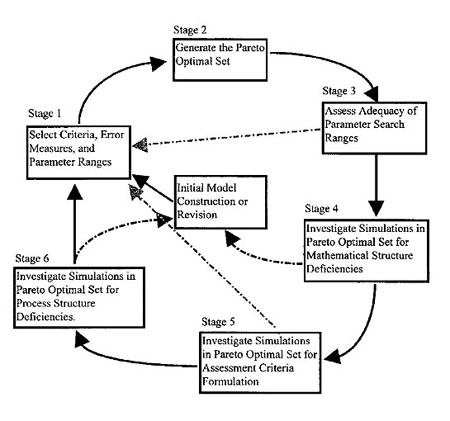
The most important problem in ecological modeling is model assessment. Many, many models have been written but how can we judge their effectiveness? The modeller may be most interested in one particular output from a model however, as a model becomes more complex and contains more parameters, there is increasing possibility that parameter values may compensate for inadequacies in the structure of the model, the problem of "over parameterization". Reynolds & Ford (1999) developed a method for model assessment designed to reduce this problem. It requires that multiple outputs from the model be examined. Ecological simulation models typically represent the interaction between many different types of ecological processes and someof the outputs can be from intermediate sub-processes so that the workings of the model can be examined in some detail; others may be theoretically derived constraints on particular processes; while others may be output data in the normal way. The ability of a model to satisfy multiple critera is assessed by calculating the Pareto Set, i.e., model parameterizations that successfully calculate different combinations of outputs. This leads to a different type of overall assessment of ecological models, not that "the model fits the data" or that "the model captures the essence of the data", but that the model is effective, or not, in its representation of different components of the ecological process. The process can be repeatedly applied as changes in made model structure. An important objective is to ensure that required outputs are not achieved while contravening known bounds for the functioning on component processes. Calculation of the Pareto set can be made by using an Evolutionary Computation algorithm. An example is given by Komuro, Ford and Reynolds (2006). This illustrates another way in which the Pareto Set can be used: where the error limit is found within which a model fits different components of a data set and the model structure is developed to achieve this. |