How do some trees grow to an age of 1000 years or even older?
In answering this question we made extensive use of the Wind River Canopy Crane Research Facility (WRCCRF) to measure crown growth and development of Douglas-fir, western red cedar and grand fir.
Our research in this area has involved field measurements using the Wind River Canopy Crane canopy crane, ropes and disection of sampled branches. Our simulation model of branch development in old-growth Douglas-fir illustrates the importance of foliage reiteration in both minimizing the length of water conduction pathways and increasing utilization of patches of light in the crown.
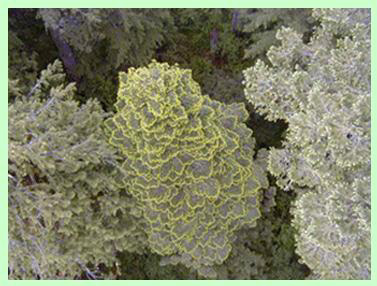
Photograph by Maureen Kennedy
On the left western red cedar; center grand fir; right Douglas-fir.
Do old-growth forests have a characteristic and distinctive spatial structure?
This question is of practical interest because some researchers have proposed that mortality in these forests is clumped, which creates gaps, and this justifies application of variable density thinning to mature plantations in an attempt to create old-growth forest conditions to enhance biodiversity. We mapped the old-growth forest at the WRCCRF and are analysing the spatial distribution of live and dead trees.