Gifford Pinchot
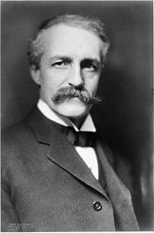
Gifford Pinchot (August 11, 1865 - October 4, 1946) was the first Chief of the United States Forest Service (1905-1910) and the Governor of Pennsylvania (1923-1927, 1931-1935). He was a Republican and Progressive. Pinchot is known for reforming the
management and development of forests in the United States and for
advocating the conservation of the nation's reserves by planned use and renewal. He called it "the art of
producing from the forest whatever it can yield for the
service of man." Pinchot coined the term conservation ethic as applied to natural resources.
Born in Simsbury, Connecticut in 1865, Pinchot graduated from Yale College in 1889, where he was a member of Skull and Bones. He studied as a postgraduate at the French National
Forestry School for a year. He returned home and plunged into the nascent forestry movement,
intent on shaping a national forest policy. Gifford Pinchot's father, James, had made a great
fortune from lumbering and land speculation but regretted the damage his work had done to the land. He made conservation a
family affair and decided that Gifford would become a forester. He endowed
the Yale School of Forestry in 1900, and he turned Grey Towers, the family estate at Milford, Pennsylvania, into a "nursery" for the American forestry movement.
Family affairs were managed by Gifford's brother Amos Pinchot, thus freeing Pinchot to do the more important work of saving America's forests. Unlike others in the forestry movement,
Pinchot's wealth allowed him to singly pursue this goal without worry of
income. Pinchot's approach set him apart from the other leading forestry experts, especially Bernhard E. Fernow and Carl A. Schenck. Fernow had been Pinchot's predecessor in the U.S. Division of Forestry before leaving in 1898 to become the
first dean of the New York State College of Forestry at Cornell. Schenck was Pinchot's successor at the Biltmore Estate (widely
recognized as the "cradle of American forestry") and
founder of the Biltmore Forest School on the Biltmore Estate. Their schools largely reflected their approaches
to introducing forestry in the United States: Fernow advocated a regional approach and Schenck a private enterprise effort in contrast to
Pinchot's national vision.