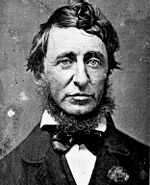
Henry David Thoreau
Henry David
Thoreau (July 12, 1817 - May 6, 1862; born David Henry Thoreau was an American author, naturalist, transcendentalist, tax resister, development critic, and philosopher who is best known for Walden, a reflection upon simple living in natural surroundings, and his essay, Civil Disobedience, an argument for individual resistance to civil government in moral opposition to an unjust state. Thoreau's
books, articles, essays, journals, and poetry total over 20
volumes. Among his lasting contributions were his writings on natural
history and philosophy, where he anticipated the methods and findings of ecology and environmental history, two sources of modern day environmentalism. He was a
lifelong abolitionist, delivering lectures that attacked the Fugitive Slave Law while praising the writings of Wendell Phillips and defending the abolitionist John Brown. Thoreau’s
philosophy of nonviolent resistance influenced the political thoughts and actions of such later
figures as Leo Tolstoy, Mohandas K. Gandhi, and Martin Luther King, Jr. Thoreau is often
claimed as an inspiration by anarchists, as well. Though Civil Disobedience calls for improving rather than abolishing
government – “I ask for,
not at once no government, but at once a better government” – the direction of this improvement
aims at anarchism: “That government is best which governs not at all; and when men are prepared
for it, that will be the kind of government
which they will have.”